🌊 Coastal
🍷 Wine Roads
🍄 Truffles
🏰 Medieval Towns
📅 3-Day sTrip
Europe has only a couple of places that can match the stunning and equally effortless road trips of Istria. This northwesternmost Croatian region lets you drive from Roman ruins, explore enchanting hilltop villages, and enjoy your evening with truffle-laced local dishes – all within short distances and in a single day.
While you can always get a guided tour, it may feel rushed in some cases. And public transport is often unreachable in inner areas. After all, Istria is more about experiencing the details than simply seeing places. This is why travellers often recommend driving to fully explore the place at a pace that you like, stop at vineyards, take detours whenever you want and discover attractions most visitors miss.
This guide offers real driving insights for a practical itinerary, related costs, and details that make a huge difference when planning a trip through the Istrian Peninsula.
🌄
Istria Road Trip Overview
Whether you have just a day or a full week, Istria’s compact size allows you to tailor your route based on time and travel style:
| Duration | Route Style | Best For |
|---|---|---|
| 1 Day | Coastal + 1 inland stop | Short visits |
| 3 Days | Balanced (coast + hills + food) | Most travellers |
| 5–7 Days | Slow exploration | Food & culture lovers |
⏱️ Distance and Average Driving Time
The journey is 150–250 km long, depending on which route you take. And you may have to drive for about 1–2.5 hours a day to cover the distance in time.
📍 Best Starting Points
- Pula (most common for travellers flying in)
- Rijeka (for easy access to the northern region)
Many travellers also enter Croatia from Italy and Slovenia due to cheap flights and car rental options. Croatia, being in the EU/Schengen zone, uses the Euro and allows easy cross-border travel, often with no routine passport checks for most European travellers.
🗺️
3-Day Istria Road Trip Itinerary
The following 3-day Istria road trip itinerary highlights the scenic routes and popular attractions that you can easily explore at a relaxed pace.
✅ Day 1: Coastal Towns & Adriatic Views
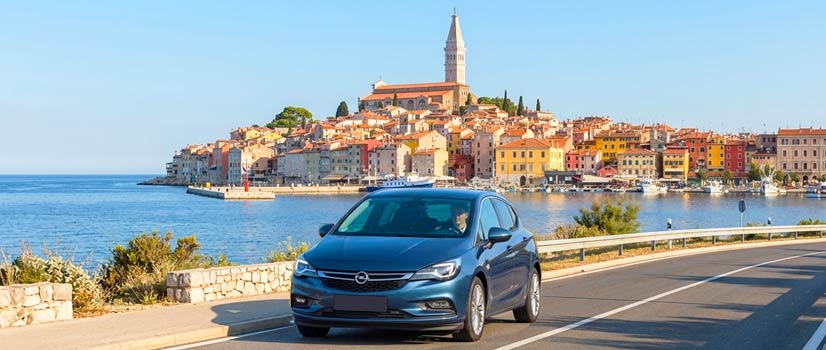
- Route: Pula → Rovinj → Poreč
- Drive time: ~1.5–2 hours total
Pula offers a glimpse of a well-preserved amphitheatre and of how the city looked at the height of the Roman Empire.
🅿️ Parking Tip
- Use designated parking areas outside Rovinj old town.
- Continue to Poreč and visit the UNESCO-listed Euphrasian Basilica.
🚗 Driving Insight
Croatian coastal roads offer the best Adriatic views and are well-maintained for easy driving.
✅ Day 2: Wine Roads & Hilltop Villages
- Route: Motovun → Grožnjan → Oprtalj
- Drive time: ~1–1.5 hours total
Inland Istria looks and feels like a quieter version of Tuscany, with vineyards, olive groves and medieval hilltop villages.
🥂 Types of Wine You Can Taste
Malvazija Istarska and Teran are among the region’s best-known wines.
☑️ Vineyards of Motovun
Fakin Winery, Tomaz Winery, Benvenuti Winery, Kozlović and Kabola are notable stops.
🍷 Top Istrian Wineries
| Winery | Location | Known For |
|---|---|---|
| Fakin | Near Motovun | Malvazija, Teran |
| Tomaz | Near Motovun | Malvazija Avangarde, Muskat |
| Benvenuti | Kaldir | Teran, Muskat |
| Kozlović | Momjan | Malvazija, Muškat Momjanski |
| Kabola | Near Buje | Organic wines |
🍴 Where to Eat
End the day at a local konoba and try fuži with truffle sauce and local Teran.
✅ Day 3: Truffle Country & Hidden Istria
- Where to Stay: Motovun, Buzet
- Drive time: Minimal, mostly local exploration
Motovun Forest
The Motovun forest along the Mirna River is considered a major truffle-hunting area.
Buzet
Buzet is renowned for its black truffles and guided truffle-hunting tours.
Livade
Livade is often regarded as the “Centre of the Truffle World.”
Paladini
The Karlić family offers guided truffle hunts through the Istrian countryside.
Pazin
Pazin offers ancient forests, hilly landscapes and access to Pazin Castle and Cave.
Mirna River Valley
The valley is considered prime growing ground for Istrian truffles.
🍄 Truffle Experiences
| Category | Details |
|---|---|
| Experience | Guided truffle hunts |
| Price Range | €70–€150 per person |
| Duration | 2–3 hours |
| Best Season | White truffles: September–December |
🏘️
Best Medieval Towns to Visit by Car
The villages of the inner Istria are compact, stone-built, and dramatically perched above valleys of vineyards and oak forests. Each one has its own character, and you can explore at least two on the same day’s drive without feeling rushed.
✔️ Motovun
Motovun is the most famous Istrian hilltop town. It was taken over by Venice in 1278 and was surrounded by solid walls that remain intact today. The walls are walkable, and the views over the Mirna Valley from the top are among the finest in Istria.
The main square within the walls features a Romanesque Town Hall and the 18th-century Churchof St Stephen. A Venetian loggia acts as the main city gate. The streets are lined with restaurants and truffle shops, so this is a good place to sit down for a meal if you’re combining the town with a wine or truffle day.
✔️ Parking Tip
Cars are not permitted inside the old town. Use the paid parking area at the base of the hill and walk up, or take the shuttle. The cobbled path is steep, so wearing comfortable shoes is best for walking.
Motovun hosts an international film festival every July, when the town fills up significantly. If you’re visiting in summer, mornings and late evenings are the best times to explore without the crowds.
✔️ Grožnjan
Grožnjan is located 228 metres above sea level, making it a stunning viewpoint over the Mirna Valley, olive groves and vineyards.
Almost every doorway in the town leads to an art studio or gallery, and the streets are filled with the sounds of different music genres, such as classical and jazz. As a result, Grožnjan is nicknamed “The Town of Artists.”
The stone used in Grožnjan’s buildings has a noticeably different colour and texture from that of other Istrian towns, giving the streets a particularly photogenic quality. Properly wandering the town requires at least an hour.
Parking Tip
The road up to Grožnjan is narrow and winding. Travellers can park just outside the walls and continue on foot.
✔️ Hum
Hum is listed in the Guinness Book of Records as the world’s smallest town, with only two streets and covering an area of roughly 35,00 square meters. Despite its size, people gather once a year to elect a mayor.
Walking or driving along the 7 km-long Glagolithic Alley, with 11 monuments from Roč to Hum, also presents striking views of the Istrian landscape.
Hum has a local brandy called biska, spiced with mistletoe and paired with local cuisine to offer the best culinary experience.
✔️ Pazin
Pazin is often referred to as the heart of Istria. It’s less visited than Motovun or Grožnjan, which makes it one of the more authentic towns in the region.
Pazin Castle is the best-preserved medieval fortress in Istria. With records dating back to the 10th century, the current-day Pazin Castle features two museums — the Pazin City Museum and the Ethnographic Museumof Istria.
The Pazin Cave, home to Istria’s largest underground river, lies just beneath the castle. The cave is open for underground tours and includes a short zipline across a lake.
Useful Tip
Pazin is one of the few inland towns with decent bus and train connections. It makes a practical base for travellers who want to explore inland Istria without a car for part of their trip.
✔️ Oprtalj
Oprtalj is located above the Mirna Valley and is notably more colourful than other hilltop towns. It is known for its medieval architecture and Venetian palaces. The palace loggia offers great panoramic views of the Istrian peninsula.
Fewer tourists make it to Oprtalj compared to Motovun or Grožnjan. Oprtalj makes an easy detour of about 30–45 minutes, along with two other popular towns.
✔️ Labin
Labin is located on a hill above the seaside resort of Rabac, and is surrounded by walls. The entrance to the old town is through a 15th-century gate. A cobbled path from the gate leads to a square with a church and a Baroque palace from 1630.
Labin is also the eastern gateway to the peninsula, making it a natural last stop if you’re ending your road trip on the Kvarner coast side. The beach town of Rabac is a short drive down the hill.
✔️ Završje
Završje is a lesser-visited Istrian town, but it is the most mystical of all Istrian hilltop towns. Most parts of the town are abandoned and covered in climbing ivy, making it a popular filming location for medieval-style productions. Built atop a prehistoric fort and strategically important to the Romans, the town has roots going back thousands of years.
🏛️ Medieval Towns at a Glance
A quick look at the towns you can visit from Motovun, and the required average drive time to each one.
| Town | Highlight | Drive from Motovun | Best For |
|---|---|---|---|
| Motovun | Walkable walls, truffle cuisine | — | Views, food |
| Grožnjan | Art galleries, panoramic views | ~25 min | Art lovers |
| Hum | World’s smallest town | ~30 min | Unique experience |
| Pazin | Castle, cave, zipline | ~20 min | History + adventure |
| Oprtalj | Venetian loggia, quiet streets | ~15 min | Off the beaten path |
| Labin | Venetian gate, coastal access | ~50 min | East coast base |
| Završje | Abandoned village, ivy-clad ruins | ~20 min | Photography |
🚘
Driving in Istria: What You Should Know
Take a quick look at the following driving tips for Istria to ensure a smooth experience on Croatian roads.
🛣️ Road Conditions
Major Coastal routes connecting cities such as Pula, Rovinj, and Poreč are generally in great condition. Even less experienced drivers find driving easy on these relatively wide and well-marked roads. There may be traffic in peak summer months, but one can manage it without any major discomfort.
Driving is rather difficult when you head inland, as the roads to hilltop towns like Motovun or Grožnjan are narrower and winding. Some steep parts and steep bends further complicate driving, requiring you to pay extra attention to stay safe.
Parts of the Parenzana trail between Oprtalj and Grožnjan road may be blocked due to landslides. Check for updates on road conditions, traffic flow, road works, tolls, and more on the website of Croatia’s national driving club, Hrvatski autoklub (HAK).
⛽ Fuel & Navigation
Fuel stations can be easily found in large towns and on major routes, but they become less and less available as you drive into inner rural areas. Top up your tank when you’re near larger hubs instead of waiting until you’re low on fuel. Prices are around €1.66–€1.85/litre for petrol/diesel, which are sometimes subject to government caps.
Mobile signal can drop in the remote parts of the Istrian peninsula’s forested or hilly areas. Download offline maps using apps like Google Maps, Waze, OsmAnd, or Maps.me before you drive to avoid any hassle if you lose connectivity on your way.
GPS apps sometimes lead drivers through gravel forest tracks near Motovun. Road name spellings may differ between apps and physical signs, so you should confirm with locals if unsure.
🅿️ Parking
Istrian towns, much like the rest of Croatia, have colour-coded parking. Some destinations, like Rovinj, may also offer paid parking spaces marked by zone numbers. Parking areas closer to the city centres are generally paid zones and may have higher charges.
Parking machines usually accept coins and cards, but it’s better to carry some cash just in case. Check the posted parking time limits, pricing, and rules at signposts to avoid improper parking and potential fines.
For a complete breakdown of local driving laws, fines, and safety requirements, refer to our driving rules and road safety guide.
🚗 Recommended Car Type in Istria
Compact crossovers and small SUVs are generally recommended by seasoned travellers for driving easily on both highway routes and the paved yet narrow village streets of Istria.
What makes them a top choice:
- A raised driving position offers the driver better visibility on narrow and curved inland roads.
- Better handling, along with more power and stability required for climbing hilltop towns.
- A relatively manageable size reduces stress when parking in old town areas and when moving through congested streets.
A compact hatchback is useful for road trips that are mostly restricted to coastal routes. But it might not perform well on steep inland inclines. And driving it may be less comfortable on difficult rural roads. A larger vehicle may be just as difficult to manage when driving through tight village streets and in limited and compact parking areas.
Driving in Istria is easy enough for most travellers and adventurous enough because of the varying road conditions in some parts. A bit of understanding of the local roads and preparation is all you need to ensure a stress-free experience.
📊
Cost Breakdown
You can get a rough idea of typical costs when touring through Croatia’s Istria region from the following table. Average rates are likely to vary based on different travel itineraries and seasonal factors.
| Expense | Average Cost |
|---|---|
| Car rental | €25–€70/day |
| Fuel | 1.66–€1.85 per litre |
| Wine tasting | €10–€25 |
| Truffle experience | €70–€150 |
Seasonal Pricing Insight
- A 40-60% price increase is common from July to August. Prices are highest because most visitors arrive during the summer.
- May, June, and September offer a mix of good weather and reasonable costs.
- October brings the best season for truffle hunting.
⁉️
Frequently Asked Questions
1️⃣ How long does it take to drive from Rovinj to Motovun?
It’s about a 45–60-minute drive from Rovinj to Motovun. The way to the hilltop is as scenic as it gets, but the route has narrow, winding roads.
2️⃣ Can I park inside Motovun?
No. Parking inside Motovun is not allowed. All visitors are required to use a paid parking area at the base of the hill. They can then take a short walk or shuttle ride to the village.
3️⃣ Do I really need a car in Istria?
A car may not be required for all travellers and itineraries, but it surely adds flexibility and comfort if you want to explore inland towns and stop by for wine tasting. Public transport to the inland and truffle country is limited or non-existent.
4️⃣ Is driving in Istria difficult for tourists?
Driving is generally easy, especially along the coast. Inland routes can be narrower and more winding, but remain manageable with careful driving. You can refer to our detailed Croatia driving rules guide for a full breakdown of rules, documents, and penalties.
5️⃣ What is the best time for an Istria road trip?
May, June, and September offer the right weather for making road trips in Istria. You can find fewer crowds and reasonable prices. But you would need to visit during Autumn (September through December) to go for truffle hunting.
6️⃣ Is driving after wine tasting allowed in Istria?
Driving after wine tasting in Istria is allowed for drivers over 25 with a blood alcohol concentration (BAC) limit of 0.50 g/kg (0.05%). But it is strictly 0.0% for drivers aged 18–24. Given the narrow roads and strict police enforcement, it’s best to have a driver who does not drink at all or take a guided tour. You can also limit tastings and plan responsibly to ensure a safe experience.
7️⃣ Are there toll roads in Istria?
Not all routes, but the main highways (such as the Istrian Y) in Istria have tolls. The Y road network connects major towns, such as Pula, Rovinj, and Poreč, to the rest of Croatia. Travellers can drive on most local and coastal scenic roads in the Istrian region without any usage fee. Expect about €5 – €15 for a short road trip on tolled routes.